
When people can open VNeID to view their medical history, referral letters, follow-up appointment slips or part of their health information, the electronic health book is no longer an unfamiliar concept. The key question for healthcare facilities is no longer “Do we need to connect or not?”
But rather: what data must be created, standardized and exchanged so that it displays correctly in the VNeID Electronic Health Book?
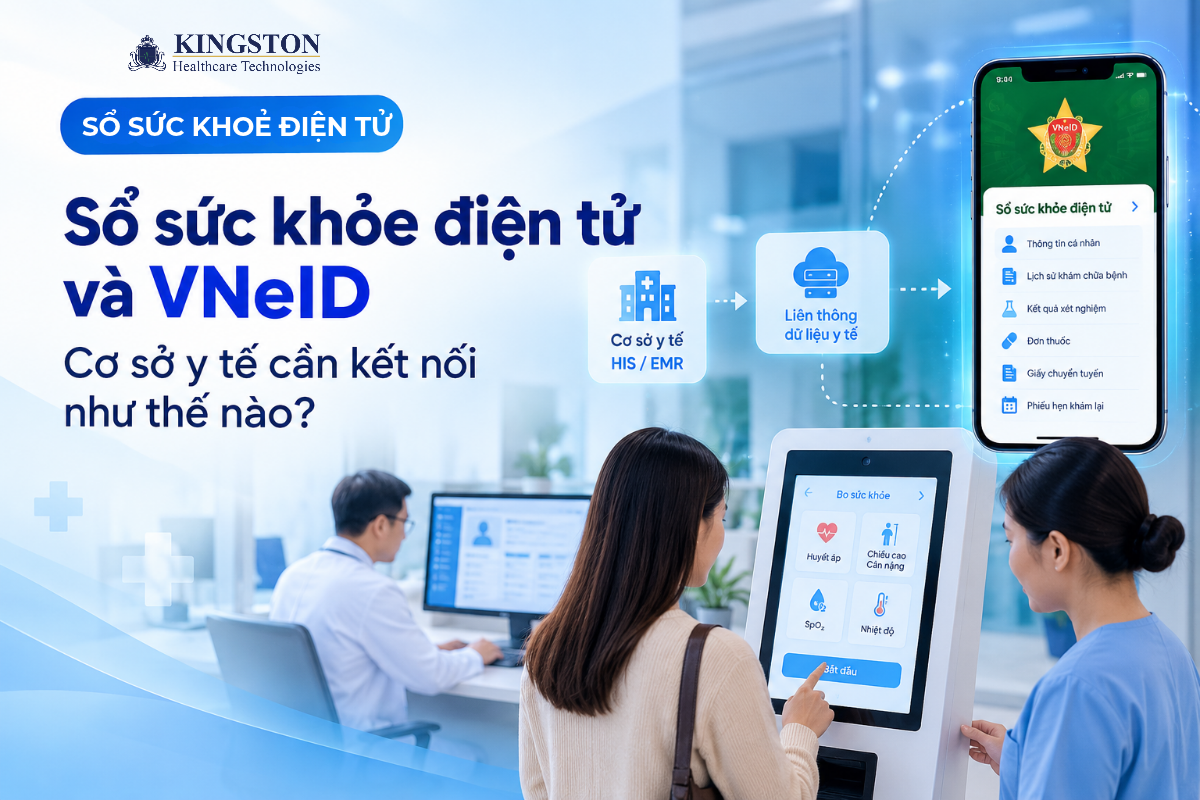
📌 Key takeaways
• Decree 102/2025/ND-CP (effective 1/7/2025): healthcare facilities are responsible for connecting, sharing and exchanging data with the Electronic Health Book on VNeID.
• From 2026: data that has been exchanged and fully displayed on VNeID can replace the corresponding paper documents in certain administrative procedures.
• Connection does not mean sending data directly into the VNeID app, but passing it through the regulated data exchange infrastructure.
• Data quality on VNeID depends on identification – standardization – exchange – verification at the source.
Under Decree 102/2025/ND-CP, effective from 1/7/2025, all legally operating healthcare facilities in Vietnam are responsible for connecting, sharing and exchanging relevant health data with the Electronic Health Book integrated into the national identification app. In 2026, the Ministry of Health continued to refine the mechanism for accessing and using VNeID Electronic Health Book data.
VNeID is gradually becoming the access point for citizens’ health data, while healthcare facilities play the role of creating accurate data right at the source.
📑 Table of contents
- What is the VNeID Electronic Health Book?
- How does the Electronic Health Book differ from electronic medical records?
- How does data flow from healthcare facilities to VNeID?
- 7 steps healthcare facilities need to take to connect
- The overall connection model
- Where does Medi-Kiosk fit in?
- Checklist before connecting
- Frequently Asked Questions
What is the VNeID Electronic Health Book?
The Electronic Health Book is a tool for updating, displaying, looking up and storing summary information about an individual’s disease prevention, examination, treatment and healthcare.
When integrated into VNeID, citizens use their electronic identification account to access health data that has been exchanged in accordance with regulations. Decree 102/2025/ND-CP also establishes the legal basis for the Electronic Health Book to replace certain related documents in the healthcare process. The information groups may include:
⚖️ Under Decision 31/QD-BYT (2026), data that has been exchanged, integrated and fully displayed on VNeID may have legal value equivalent to the corresponding paper documents in administrative procedure dossiers. See also: Ministry of Health guidance on deploying the Electronic Health Book on VNeID.
Is the Electronic Health Book the same as an electronic medical record?
These are two related but different concepts:
Electronic medical record – EMR
Detailed clinical record
Created and managed by the healthcare facility during treatment: clinical progress, medical orders, tests, diagnostic imaging, medications, surgeries and procedures, nursing care, signatures and clinical confirmation.
VNeID Electronic Health Book
A citizen-centered summary information layer
Summarized, continuous health information compiled from data exchanged from appropriate sources.
Learn more about the EMR roadmap: Electronic medical records: the roadmap to going paperless from 1/1/2027. The relationship between the two data layers can be pictured as follows:
Therefore, VNeID does not replace the HIS or EMR of a hospital. It is part of a broader data ecosystem.
How does data flow from healthcare facilities to the VNeID Electronic Health Book?
According to the Ministry of Health’s deployment guidance, after a medical visit ends, summary information is recorded in the facility’s system and exchanged to the data-receiving infrastructure for display in the VNeID Electronic Health Book. In principle, the connection flow consists of 5 layers:
Data exchange must follow the architecture, data standards, intermediary infrastructure and technical guidance issued by the competent authorities at each point in time.
7 steps healthcare facilities need to take to connect to the Electronic Health Book
1. Start with patient identification
Health data only has value when it belongs to the right person.
A healthcare facility may be using many different identifiers:
If systems do not share a unified identification mechanism, data is at risk of:
Therefore, before connecting to VNeID, facilities need to review how the HIS, EMR, LIS, PACS and devices identify patients.
2. Standardize data right in the HIS/EMR
VNeID cannot fix incomplete data from the source. If information is entered incompletely, in the wrong structure or inconsistently, the subsequent data exchange will also run into problems. Facilities need to check:
The Ministry of Health has issued information field sets for displaying the VNeID Electronic Health Book; implementation continues to be adjusted according to the data architecture and current guidance.
3. Connect medical devices to the source system
This part is easily overlooked. For example, a patient has measurements taken for:
If nurses still have to follow a manual process:
then the data is already “broken” from the very first step. A better architecture aims for:
This does not mean all data from every device automatically goes to VNeID. Facilities need to determine which data falls within the sharing scope, which standards are required and which system is responsible for sending it. Learn more: Where does health data go after it is measured?
4. Check the interoperability of your HIS/EMR
The IT department needs to work with system vendors to determine:
Don’t wait until data does not appear on VNeID to start checking these issues.
5. Build a post-exchange verification mechanism
Facilities should have an end-to-end verification process:
Some KPIs that can be tracked:
| Indicator | Objective |
|---|---|
| Rate of successfully sent records | Check exchange capability |
| Rate of failed records | Detect data issues |
| Rate of missing information fields | Check source data quality |
| Rate of misidentified records | Check patient matching |
| Time from end of visit to data exchange | Assess processing speed |
| Rate of records needing correction and resending | Assess stability |
This step turns “technical connection” into a controllable operational process.
6. Don’t overlook security and privacy
Health data is highly sensitive. The Ministry of Health requires that accessing, using and sharing VNeID Electronic Health Book data comply with regulations on security, information safety and personal privacy. Healthcare facilities need to control:
Security must be designed together with the architecture from the start, not added as a final step after the system has been connected.
7. Redesign the patient journey
The VNeID Electronic Health Book will create little value if facilities see it only as a “data submission” task. The greater value lies in using existing information to reduce effort for patients: instead of asking them to declare information again, facilities can use appropriate data in accordance with regulations.
According to Ministry of Health guidance, doctors and healthcare staff may use information in the VNeID Electronic Health Book to support examination and treatment; electronic follow-up appointment slips and referral letters have also been brought into scope.
Not enough
“The hospital can connect to VNeID.”
The real goal
“Patients don’t have to provide information the system already has.”
How should the Electronic Health Book connection model be pictured?
A general connected healthcare architecture can be viewed as a two-way flow:
Key point: VNeID should not become a separate system where staff have to enter extra data by hand. Data should be created within normal clinical workflows, then standardized and exchanged. If staff have to enter data into the HIS and then into another system just for VNeID to display it, that architecture will be hard to scale.
The VNeID Electronic Health Book and electronic medical records must go hand in hand
Vietnam is simultaneously promoting two directions in healthcare digital transformation:
Depth
Electronic medical records
Digitizing detailed clinical data within each healthcare facility.
Continuity
VNeID Electronic Health Book
Helping citizens access part of their health data across many episodes of care.
When these two layers are well connected, data no longer ends after a single visit but continues to support future care.
Where does Medi-Kiosk fit in this model?
Medi-Kiosk by Kingston Healthcare Technologies is not an Electronic Health Book and does not replace the HIS/EMR. Medi-Kiosk’s role lies in the initial data creation point. Depending on configuration, the device can record:
Instead of staff reading results from multiple devices and entering them by hand, data can be digitized right at the point of measurement. In a suitable architecture, the data flow can be designed as:
ℹ️ Specific integration capability depends on the APIs, system architecture, data scope and technical requirements of each project.
For data in the Electronic Health Book to be good, digitization must start where the data is created.
Checklist for healthcare facilities before connecting to the Electronic Health Book
Before deploying or reviewing a VNeID connection, healthcare facilities should answer 7 questions:
01 · Identification
Are patients identified consistently across systems?
02 · Data
Are the required information fields complete and correctly structured?
03 · HIS/EMR
Can the software exchange data as required?
04 · Devices
Do vital signs and paraclinical data still need to be entered manually?
05 · Exchange
Is there a mechanism for sending, receiving status and resending on error?
06 · Security
Have access rights, logs and data protection been set up?
07 · Verification
Does the facility verify data after exchange or only check that it was “sent”?
If these 7 questions can’t be answered yet, the VNeID connection may only be at a technical level, not yet truly part of the digital healthcare process.
Conclusion
The VNeID Electronic Health Book is not just a feature of the identification app but part of a larger process of building continuous, citizen-centered health data. Decree 102/2025/ND-CP sets out healthcare facilities’ responsibility to connect, share and exchange data; from 2026, data fully displayed on VNeID can increasingly replace paper documents in applicable procedures.
For healthcare facilities, the challenge is not just “connecting to VNeID” but building a flow of:
Frequently asked questions about the VNeID Electronic Health Book
Which healthcare facilities must connect to the Electronic Health Book?
Under Decree 102/2025/ND-CP (effective from 1/7/2025), all legally operating healthcare facilities in Vietnam are responsible for connecting, sharing and exchanging relevant health data with the Electronic Health Book integrated into VNeID.
Does the Electronic Health Book replace electronic medical records?
No. An electronic medical record is the detailed clinical record at a facility; the Electronic Health Book is a citizen-centered summary layer compiled from exchanged data.
Do healthcare facilities send data directly into the VNeID app?
No. Data is exchanged through the receiving infrastructure designated by the regulator, in line with current data standards and technical guidance.
Does data in the VNeID Electronic Health Book have legal value?
Under Decision 31/QD-BYT (2026), data that has been exchanged and fully displayed on VNeID may have value equivalent to the corresponding paper documents in administrative procedure dossiers.
How does Medi-Kiosk support VNeID connection?
Medi-Kiosk digitizes health measurements right at the point of measurement, reducing manual entry and making source data more standardized before it enters the HIS/EMR and exchange infrastructure, when integration requirements are met.
Kingston Healthcare Technologies – Connecting data from the point of care
KHT develops Medi-Kiosk, Medi-Case and digital health solutions toward a seamless data journey between users – devices – healthcare facilities – health management systems.
Note: This content provides general information. Specific connection architectures must follow the technical guidance, data regulations and requirements of the competent authorities at the time of deployment.