
Health kiosks in community healthcare are becoming an approach of interest to many localities, helping to gradually shift from a model where people wait until they go to a healthcare facility to one of proactive disease prevention, early screening, and health management right in the local area.
This direction is especially important as non-communicable diseases and an aging population increasingly put pressure on the healthcare system. Vietnam is also prioritizing the strengthening of grassroots healthcare, expanding screening examinations, and bringing primary healthcare services closer to people's living environments.
🏘️ In this model, health kiosks in community healthcare can serve as an initial screening point, helping people check certain health indicators, digitize results, and connect with healthcare staff when needed.
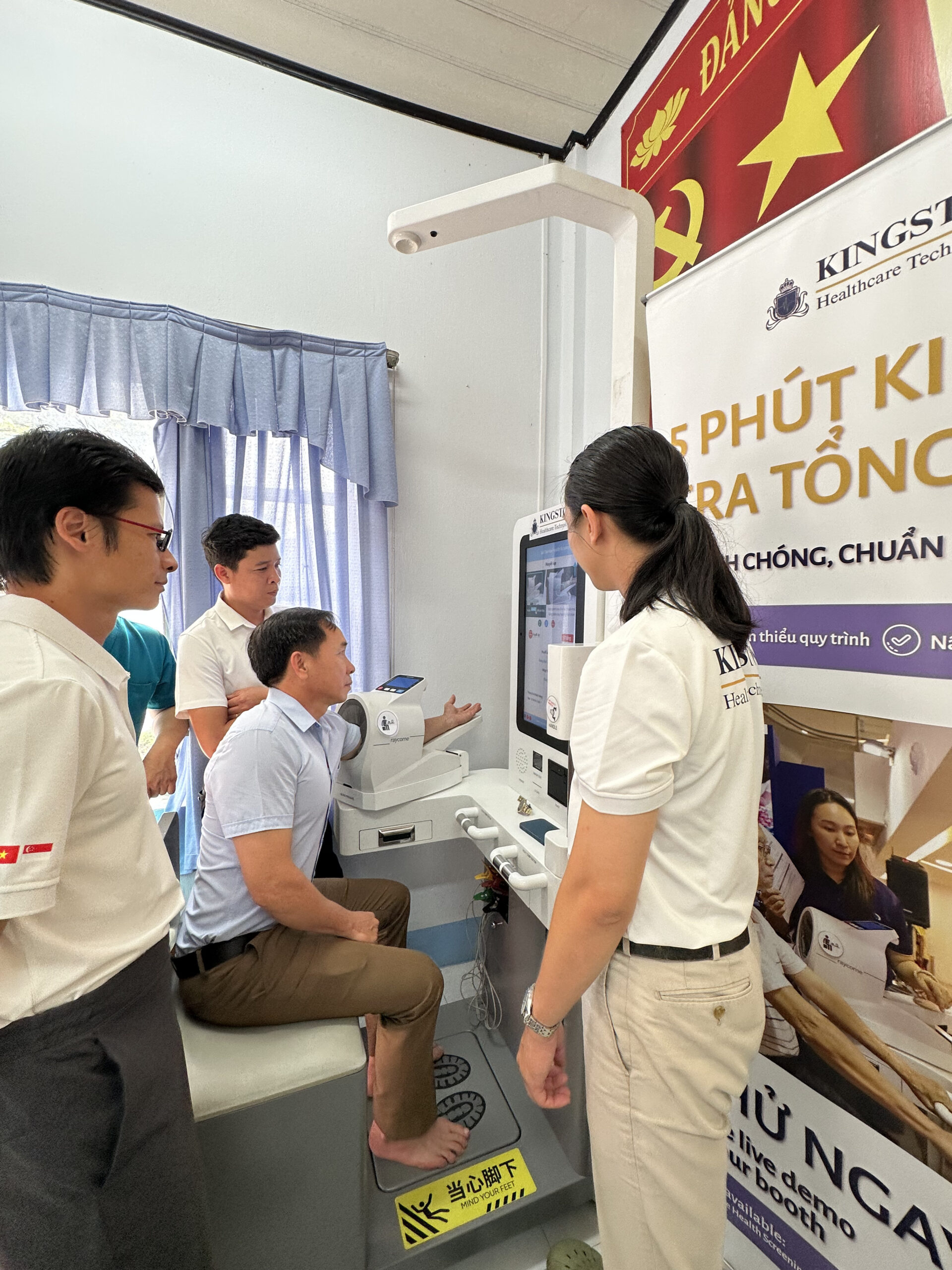
Medi-Kiosk deployed at a commune health station, helping people check their health right in their local area
What is a health kiosk in community healthcare?
A health kiosk is a screening station integrated with measurement devices, a guided-instruction screen, and a data management platform.
Depending on the configuration, a kiosk can help record:
✅ Height, weight, and BMI
✅ Blood pressure
✅ Heart rate
✅ SpO₂
✅ Body temperature
✅ Body composition
✅ Some additional indicators depending on project needs
Unlike administrative kiosks that only handle registration or queue numbers, a health check-up kiosk focuses on collecting vital sign data and supporting initial assessment.
The device can be placed at commune or ward health stations, administrative centers, cultural houses, community activity venues, or mobile check-up programs. This flexibility helps health kiosks in community healthcare reach many different population groups.
Why is it necessary to bring screening closer to the people?
Primary healthcare includes not only treatment when someone is sick but also health promotion, disease prevention, early detection, chronic disease management, and long-term monitoring right within the community. The WHO states that primary healthcare should be provided as close as possible to people's everyday living environments.
In practice, local screening activities still face several challenges:
✅ People do not yet have the habit of regular health check-ups
✅ Health stations have limited human resources and equipment
✅ Data from check-up campaigns is not managed continuously
✅ Elderly people or those living far from centers have difficulty accessing services
✅ Community programs are often held periodically, making it hard to maintain follow-up after screening
✅ Healthcare staff must perform many manual measurement and record-keeping tasks
Setting up a convenient screening point can help people access health check-ups earlier, before clear symptoms appear. In other words, deploying health kiosks in community healthcare is the answer to this access challenge.
1. Supporting initial health screening at the local level
A health kiosk allows people to perform certain basic measurements following a process guided on the screen. This is the first and most important step when deploying health kiosks in community healthcare in a specific area.
A single usage session may include:
Identifying the user → Guiding the steps → Measuring indicators → Saving results → Referring to healthcare staff.
The data collected helps identify indicators that need to be re-measured or further assessed, such as blood pressure, heart rate, SpO₂, or physical condition.
Screening is not the same as diagnosis. However, it is an important step for early identification of people who need monitoring or referral to an appropriate healthcare facility.
WHO also emphasizes that detection, screening, and management of non-communicable diseases can be carried out through the primary healthcare system to support early detection and timely treatment.
2. Reducing repetitive tasks for grassroots healthcare staff
In community health check-up programs, healthcare staff often have to continuously perform tasks such as:
✅ Measuring height and weight
✅ Measuring blood pressure
✅ Recording results on forms
✅ Re-entering data into a computer
✅ Compiling the list of participants
✅ Classifying cases that need follow-up
When devices are integrated into a kiosk, results can be recorded directly on the platform instead of being manually re-entered.
This allows healthcare staff to focus more on:
✅ Assisting elderly people or those with difficulties
✅ Checking measurement quality
✅ Assessing results that need attention
✅ Health consultation
✅ Monitoring people with risk factors
✅ Coordinating referrals when needed
KHT expert perspective: The value of a kiosk lies not in replacing healthcare staff, but in reducing repetitive tasks so that grassroots healthcare teams can spend more time on assessment, consultation, and managing people's health.
3. Digitizing community health screening data
One of the limitations of periodic check-up programs is that results are often recorded on paper or stored in separate, scattered files.
This makes it difficult for localities to:
✅ Track each person's history
✅ Compare results between check-ups
✅ Identify groups with indicators that need attention
✅ Compile reports by area
✅ Evaluate program effectiveness
✅ Develop follow-up care plans
A health kiosk can help digitize data right at the point of measurement. Depending on the scope of deployment, results can be stored on a management platform or studied for connection with electronic health records and healthcare facility systems. As a result, health kiosks in community healthcare go beyond simple measurement and contribute to building a population health database.
Data is only truly valuable when it is correctly linked to a user, updated over time, and placed within a clear monitoring process.
4. Supporting continuous health management, not just a one-time check-up
A screening program is only meaningful in the long term when the results are used for the next step of care.
For example, after identifying someone with blood pressure that needs attention, the grassroots healthcare system needs a plan to:
✅ Guide a re-measurement
✅ Invite the person to visit the health station
✅ Advise on lifestyle changes
✅ Refer to a doctor for assessment
✅ Monitor indicators periodically
✅ Refer to a higher-level facility if needed
An effective community care model needs to shift from “measure and return results” to “measure, identify risk, monitor, and intervene appropriately.”
This also reflects a shift from being a place for medical examination to a place for managing people's health, from passive care to proactive and continuous care within the community.
5. Expanding access across many areas
A health kiosk can be flexibly deployed at:
✅ Commune or ward health stations
✅ Local health centers
✅ Public administrative centers
✅ Cultural houses or community activity venues
✅ Elderly care programs
✅ Rural areas or areas far from centers
✅ Health screening events
✅ Mobile check-up points
For localities with a large area, the model can combine fixed kiosks with mobile check-up solutions to reach more population groups. This is also the approach that Kingston Healthcare Technologies has implemented in practice together with partners, as in the cooperation program to promote the application of technology in community healthcare.
A kiosk does not replace the full capacity of a health station. The device serves as an additional data collection and screening support point, while healthcare staff continue to be responsible for professional assessment and managing people after measurement. This is the long-term value of health kiosks in community healthcare: expanding coverage without adding to staffing pressure.
A health kiosk model within the community care system
A deployment model can be organized as follows:
In this model, the kiosk is the starting point of the data flow, not the end point of the care process.
Kingston Healthcare Technologies' Medi-Kiosk
Medi-Kiosk by Kingston Healthcare Technologies (KHT) is developed by integrating digital health devices, a guided-instruction interface, and a data management platform in a single screening station. You can also refer to health checkup process using kiosks for a clearer picture of the actual operating steps.
Depending on project needs, Medi-Kiosk can be studied for deployment at:
✅ Commune or ward health stations
✅ Medical examination and treatment facilities
✅ Community health programs
✅ Elderly care points
✅ Administrative or residential areas
✅ Programs coordinated between local authorities, healthcare facilities, and social organizations
Depending on the configuration, the device can support basic indicators such as height, weight, BMI, blood pressure, heart rate, SpO₂, and body temperature.
The functions, scope of integration, and result delivery format need to be determined based on each project's infrastructure conditions and objectives. These are factors that need careful consideration before putting health kiosks in community healthcare into official operation.
🏘️ Explore the Medi-Kiosk solution for communities and grassroots healthcare
The KHT team can help survey needs, identify priority groups, select a configuration, and develop a deployment plan suited to a health station, locality, or community healthcare program.
⚠️ Medical note: Screening measurements provide preliminary information only. They do not replace medical examination, diagnosis or treatment by qualified healthcare professionals. Measurement results from the kiosk are for screening and initial reference purposes only, and do not replace examination, diagnosis, consultation, or treatment by qualified doctors and healthcare staff.