
When considering deploying a health check-up kiosk, many hospitals, clinics, businesses, and health stations often ask: Do health kiosks replace healthcare staff?
Health kiosks do not replace healthcare staff — they help them work more effectively
Health kiosks are designed to automate repetitive tasks such as guiding measurements, recording indicators, and syncing data. Meanwhile, healthcare staff still play a core role in professional assessment, consultation, handling abnormal results, and patient care.
Rather than replacing people, kiosks help redistribute work: machines handle the steps that can be standardized, while healthcare staff focus on tasks that require expertise and direct interaction. This is the answer to the question of whether health kiosks replace healthcare staff.
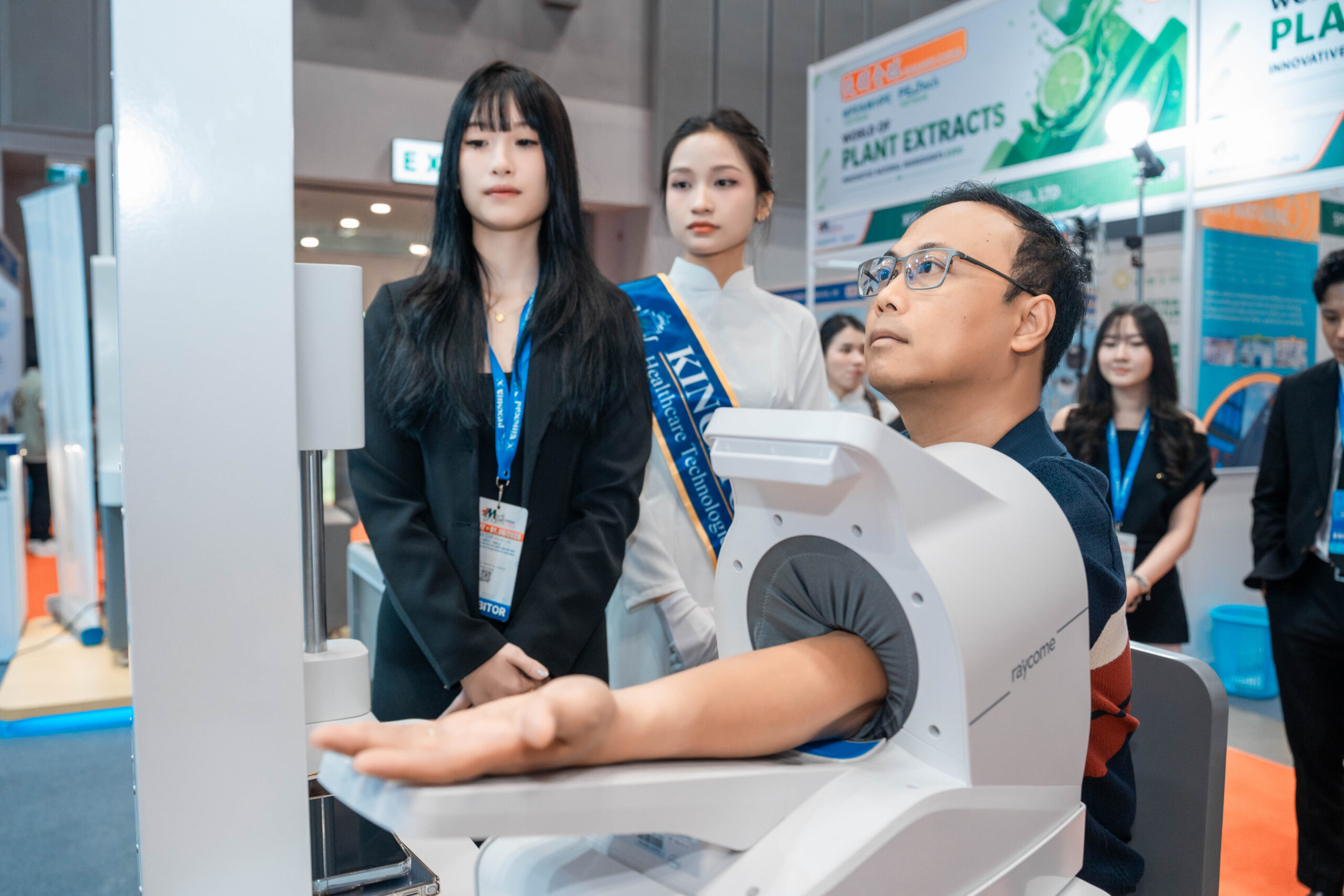
Staff assisting a user at a health kiosk in a real-world deployment
What tasks can a health kiosk handle?
A health check-up kiosk can support part of the initial screening process, including:
These tasks tend to follow a relatively fixed process and are prone to repetitive actions when the number of users is large.
Once automated, healthcare staff no longer need to read results from each device and re-enter them manually, giving them more time for professional work.
Tasks a health kiosk cannot replace healthcare staff for
Although it can collect many indicators, a kiosk cannot replace the assessment and decision-making ability of healthcare staff.
Assessing the patient's condition
An abnormal reading does not always indicate a medical condition. Blood pressure can rise due to stress, heart rate can change after physical activity, and SpO₂ can be affected if the sensor is not positioned correctly.
Healthcare staff need to consider results in relation to:
A kiosk only provides initial data and cannot fully assess each person's health context on its own.
Handling results that need attention
When an indicator falls outside the reference range, the system may prompt a re-measurement or send an alert. However, it is healthcare staff who decide:
Consultation and explanation of results
A result on a screen cannot replace the exchange between a patient and healthcare staff.
Users may need an explanation of what an indicator means, how to monitor it, what factors affect it, and when to visit a health facility. This is work that requires professional knowledge, communication skills, and empathy.
Diagnosis and treatment
A health check-up kiosk is not a standalone diagnostic tool. The device cannot replace:
All results from a kiosk should be used strictly for screening and initial reference purposes. This is the clearest boundary when discussing whether health kiosks replace healthcare staff.
How does the role of healthcare staff change?
In a traditional process, healthcare staff may need to spend a lot of time on tasks such as guiding each person, measuring vital signs, recording results, and entering data.
When a kiosk is applied, the staff's role gradually shifts from performing manual tasks sang supervision, support, and professional assessment. This trend aligns with the recommendations of World Health Organization (WHO) on applying digital technology to support, not replace, healthcare staff.
This shift allows healthcare human resources to be used more efficiently, especially at locations with high user traffic.
Does a kiosk help reduce operational pressure?
A kiosk can help reduce some operational pressure when placed in the right location and integrated into an appropriate workflow. This is also an important aspect when assessing whether health kiosks replace healthcare staff in reducing repetitive workloads.
Some of the value that can be achieved includes:
However, a kiosk does not automatically create efficiency if it is simply installed as a standalone device. The deploying facility still needs to clearly define processes before, during, and after users take measurements.
When is staff support still needed at a kiosk?
Although kiosks are designed to be self-service, some groups of users may still need assistance:
In the early stages of deployment, having staff positioned near the kiosk area also helps the facility observe user behavior, identify points of inconvenience, and adjust the process accordingly.
The goal of this model is not for users to have no contact with healthcare staff at all, but to ensure that support is provided to the right person at the right time.
A model of collaboration between kiosks and healthcare staff
To better answer the question of whether health kiosks replace healthcare staff or not, one can picture an effective collaborative process organized as follows:
In this model, the kiosk is responsible for collecting and standardizing data. Healthcare staff are responsible for interpretation, decision-making, and caring for the user.
How does Medi-Kiosk support healthcare staff?
Medi-Kiosk by Kingston Healthcare Technologies (KHT) is developed by combining health measurement devices, a guided interface, and a data platform in a single screening station. This is also practical proof of whether health kiosks replace healthcare staff or not: the solution is designed to support, not replace, healthcare teams.
Depending on the project configuration, Medi-Kiosk can help record basic indicators such as:
Results are digitized right at the point of measurement and can be studied for connection with each unit's appropriate management system.
Medi-Kiosk is not positioned to replace doctors or nurses. The solution is aimed at supporting healthcare teams by:
The solution may be considered for hospitals, clinics, health stations, businesses, industrial parks, and community healthcare programs.
Conditions for a kiosk to effectively support staff
For a kiosk to fulfill its role properly, the deploying facility needs to prepare, since the effectiveness of the collaboration between kiosk and people determines whether the health kiosk replaces healthcare staff or simply supports them:
Clear operating procedures
It is necessary to define who is in charge of the kiosk, which cases require re-measurement, when to refer to healthcare staff, and who has access to view results.
Staff training
Staff need to be trained on how to assist users, check measurement quality, handle errors, and respond when results requiring attention are found.
Proper placement
The kiosk should be placed in a convenient area with a power source, network connection, and enough space for users to take measurements safely.
Regular equipment maintenance
Measurement devices need to be cleaned, inspected, maintained, and calibrated according to instructions to maintain data quality.
Evaluating effectiveness after deployment
The facility can track the number of uses, self-completion rate, rate of users needing assistance, number of repeated measurements, and user satisfaction level.
⚠️ Medical note: Screening measurements provide preliminary information only. They do not replace medical examination, diagnosis or treatment by qualified healthcare professionals. Measurement results from the kiosk are for screening and initial reference purposes only, and do not replace examination, diagnosis, consultation, or treatment by qualified doctors and healthcare staff.
Contact Kingston Healthcare Technologies for advice on the right deployment model for your organization.