
Periodic health checkups are an important part of employee care. Vietnamese law requires employers to organize periodic health checkups every year, and some groups of workers must be examined at least once every six months.
⚠️ The operational challenge: For enterprises with hundreds or thousands of employees, the question is how to reduce disruption from periodic health checkups while keeping production lines running, avoiding longer time away from workstations and preventing congestion at the checkup area.
The solution is not to cut the content of the checkup, but to redesign the process. Below are 7 techniques that help enterprises reduce disruption from periodic health checkups more effectively while maintaining operations.
1. Schedule Checkups by Shift and Operating Unit
Avoid calling all employees in for checkups at the same time.
Enterprises should divide the schedule by:
Each time slot should only include as many people as the checkup provider can handle. In factories, the schedule should be developed together with production managers to avoid pulling too many employees from a single line at the same time.
This approach helps maintain minimum staffing in each department and prevents employees from waiting too long.
2. Complete Registration Before Checkup Day
A significant portion of time at the checkup site is often spent checking lists, filling in information or correcting data errors.
Before checkup day, enterprises should finalize:
Information can be collected through digital forms or synced from the HR system, with appropriate access control and data protection.
On arrival at the checkup site, employees simply scan a code or confirm their record instead of re-entering all their information.
3. Separate Quick Steps from Clinical Steps
Not every checkup item needs to be performed in the same area.
Enterprises can divide the process into three groups:
Standardized measurements should be placed before the doctor’s area. By the time employees reach the clinical examination room, their initial data is ready for the doctor to review.
This setup helps prevent people from having to go back multiple times or wait for a single staff member to carry out every step.
4. Organize Checkups On-site
For enterprises with a large workforce, sending all employees to a healthcare facility can mean long travel times and make it hard to control when they return to work.
Organizing checkups at the office or factory helps:
The checkup site should be divided into clearly defined zones, with separate entrances and exits if possible. Sample collection, measurement and doctor consultation areas should also be arranged in the correct sequence to avoid crossover.
5. Use Kiosks for Initial Screening Measurements
Basic measurements are repetitive and can become a bottleneck when medical staff have to measure, record the results and then re-enter them into the system.
Medi-Kiosk by Kingston Healthcare Technologies (KHT) is designed to support the measurement of several health indicators, guide users on screen and digitize data right at the point of measurement.
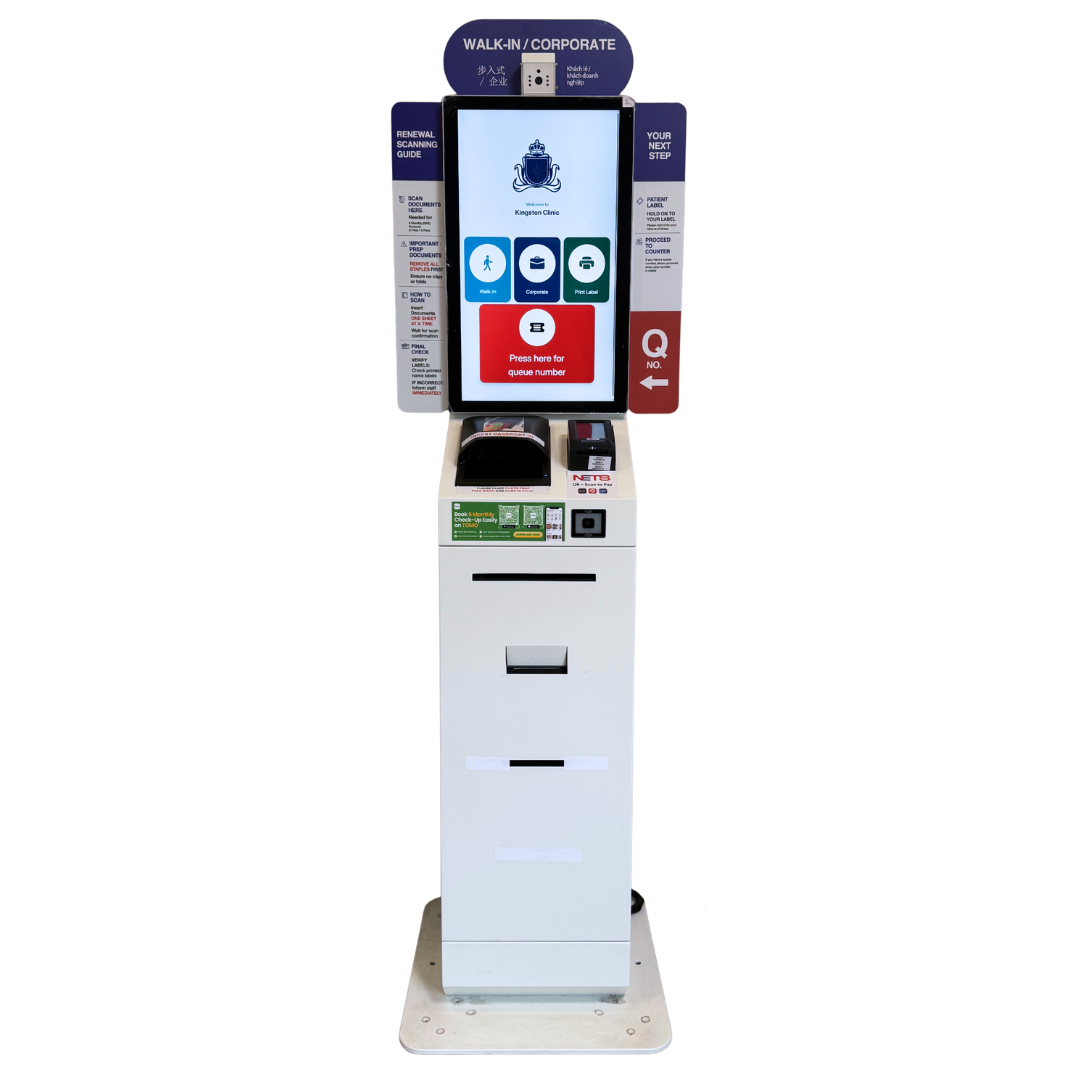
Depending on the configuration, Medi-Kiosk can support:
In corporate checkup programs, kiosk can be placed in the screening area before employees see the doctor. This helps standardize the measurement sequence and reduce manual data entry.
Medi-Kiosk does not replace the content of periodic health checkups, doctors or mandatory lab tests. The device supports initial data collection and optimizes the operational flow.
6. Design a One-Way Flow and Control Bottlenecks
An efficient checkup process should minimize employees moving backwards or having to return to areas they have already completed.
A reference flow may include:
→
→
→
→
→
Before checkup day, enterprises should estimate the processing capacity of each station. If the measurement area serves 60 people per hour but the doctor’s room can only handle 30, a queue will still form at the clinical examination step.
Therefore, the number of examination desks, staff and equipment should be balanced according to the station with the lowest capacity, rather than simply adding more at the intake step.
7. Run a Pilot and Monitor Data on Checkup Day
For large-scale programs, a pilot with a small group should be held before the official rollout.
The pilot helps check:
On checkup day, monitor the number of people waiting in each area and adjust the employee call schedule in real time.
CDC recommends that workplace health programs be built in a coordinated, systematic way with continuous evaluation, rather than as a series of disconnected activities. WHO also regards the work environment as an important part of strategies to protect and promote workers’ health.
Indicators to Measure After the Program
To assess the level of operational disruption, enterprises can track:
This data should be used to improve the process for the next checkup, not just to produce a post-event report.
Proposed Implementation Model
A low-disruption corporate health checkup model can be organized as follows:
This model combines the requirements of periodic health checkups with proactive health management, helping enterprises not only complete a round of checkups but also build a foundation for long-term monitoring.
⚠️ Medical note: Screening measurements provide preliminary information only. They do not replace medical examination, diagnosis or treatment by qualified healthcare professionals. Medi-Kiosk supports screening and initial data collection; it does not replace periodic health checkup programs, diagnoses or doctors’ conclusions.
Want to reduce disruption from periodic health checkups at your company?
Kingston Healthtech works with enterprises to design streamlined periodic health checkup processes, using Medi-Kiosk to reduce waiting times and optimize operations.