
Electronic medical records are moving from an optional technology project to a mandatory requirement. From 1/1/2027, public and private hospitals are required to stop using paper medical records. Before that, healthcare facilities within the scope of implementation must complete their electronic medical records no later than 31/12/2026.
This is not simply a move from paper to computers. Implementing electronic medical records (EMR) requires healthcare facilities to prepare infrastructure, data, workflows, electronic signatures, device integration and operational capacity at the same time.
📌 Key takeaways
• 31/12/2026: deadline to complete the rollout of electronic medical records.
• 1/1/2027: public and private hospitals stop using paper medical records.
• Going paperless is not about scanning old records but about redesigning how medical data is created, verified, used and stored.
• Success depends on 3 pillars: workflows – integration – operational testing.
📑 Table of contents
- What is an electronic medical record?
- The EMR implementation roadmap in Vietnam
- What does “going paperless” really mean?
- 7 things healthcare facilities must do now
- 5 mistakes that leave EMR projects “half-digitized”
- From electronic medical records to a digital health ecosystem
- The role of Medi-Kiosk
- What should healthcare facilities prioritize now?
- Frequently Asked Questions
What is an electronic medical record?
Electronic medical records are medical records created, updated, stored and used in electronic form instead of paper throughout the care process. An electronic medical record may include:
The key point is that data must not only be stored electronically but also be linked to the right patient at the right time, retrievable, and compliant with legal and clinical requirements.
The EMR implementation roadmap in Vietnam
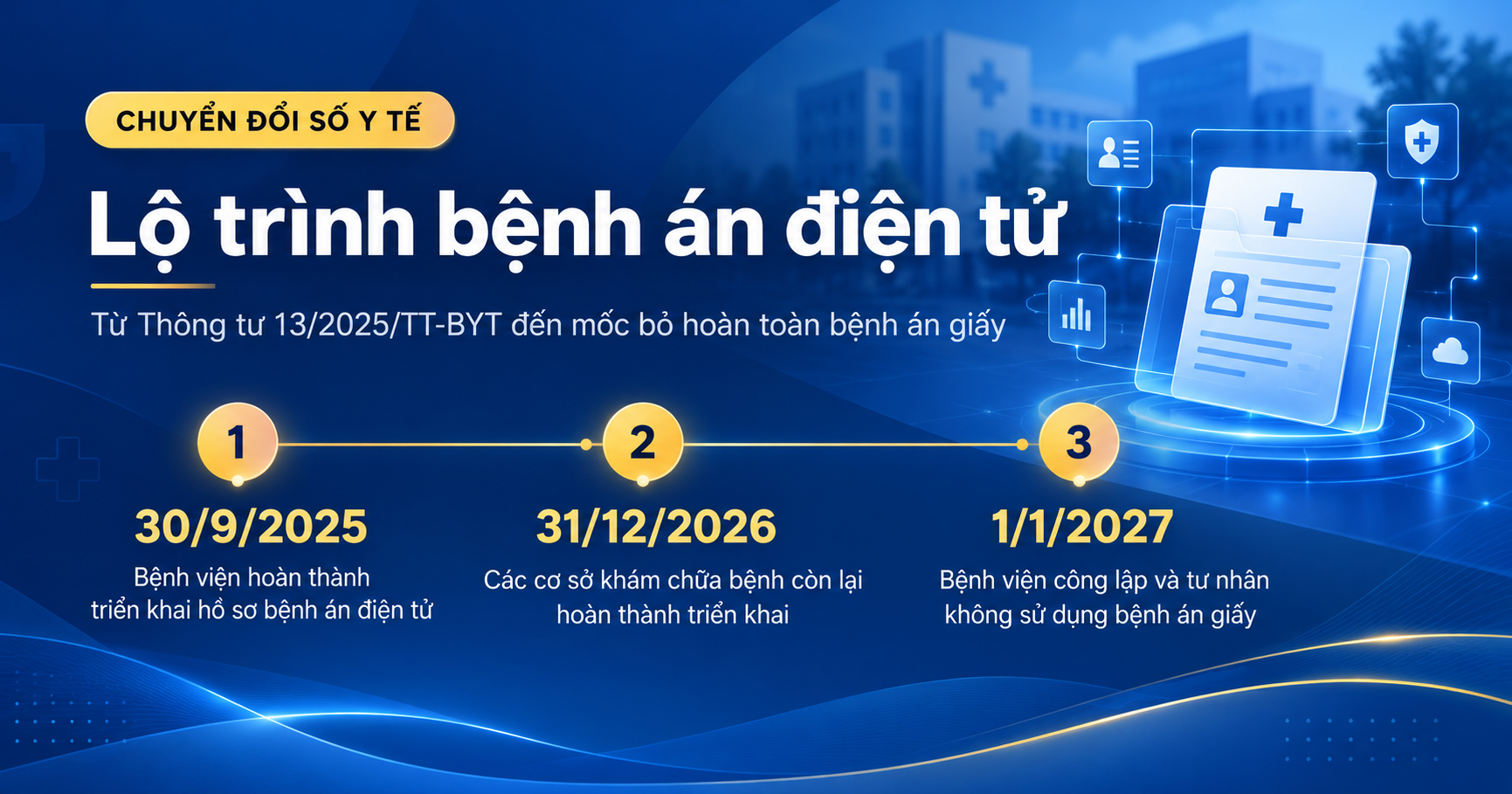
Circular 13/2025/TT-BYT of the Ministry of Health, effective from 21/7/2025, sets out the roadmap for implementing electronic medical records. In April 2026, the Minister of Health issued Directive 04/CT-BYT, requiring facilities to review their current status, mobilize resources and ensure completion on schedule.
| Milestone | Scope / requirement | Legal basis |
|---|---|---|
| 30/9/2025 | Hospitals complete the rollout of electronic medical records | Circular 13/2025/TT-BYT |
| 31/12/2026 | Other healthcare facilities providing inpatient, day-care or outpatient treatment complete the rollout | Circular 13/2025/TT-BYT, Directive 04/CT-BYT |
| 1/1/2027 | Public and private hospitals stop using paper medical records | Directive 04/CT-BYT |
From 1/1/2027, public and private hospitals will no longer use paper medical records.
This milestone shows that electronic medical records have become a core priority in healthcare digital transformation. See the official announcement on the Can Tho City Legal Education Portal.
What does “going paperless” really mean?
A common misconception is that scanning paper records into PDF is enough. In reality, a complete electronic medical record workflow must ensure that data is created and processed directly in a digital environment.
Traditional process
Electronic medical record process
Scanned PDF
Digitizing the format
Paper is replaced by image files. Data is still created manually and is hard to search and connect.
A true electronic medical record
Digitizing the data flow
Structured data from the start, linked to the right patient and used throughout the care journey.
7 things healthcare facilities must do now to implement electronic medical records
1. Review every workflow that still relies on paper records
The first step is not buying software. Healthcare facilities need to map their current workflows:
At each step, answer four questions:
This is the basis for identifying the “breaking points” in the journey of digitizing healthcare facilities.
2. Assess the capabilities of your current HIS and EMR
Not every HIS is a complete EMR. Facilities should assess whether the system:
The key is to treat the electronic medical record system as part of the overall data architecture, not as standalone software.
3. Solve patient identification
Correct data linked to the wrong patient is still wrong data.
That is why hospitals need a single, consistent identification mechanism across:
If each system uses a different ID and records must be matched manually, the risk of duplicate records or mismatched data increases. This is the foundation to put in place before integrating additional devices or systems.
4. Connect data from medical devices
One commonly overlooked area is data from devices at the point of care. For example, nurses measure:
If results still have to be read from the device and re-entered into the EMR, the workflow still contains a manual step that costs time and invites errors. The goal should be:
Learn more: Where does health data go after it is measured?
5. Standardize electronic signatures and confirmation
A medical record contains not only data but also clinical accountability. Healthcare facilities need to define clearly:
Circular 13/2025/TT-BYT requires signing and confirmation methods to be organized in line with current regulations. Electronic signatures should therefore be designed together with the workflow from day one, not added as a final step of the project.
6. Prepare infrastructure, security and contingency plans
A paper record can be opened by hand. An electronic medical record depends on:
If the network goes down or a server fails, how will the hospital keep seeing patients?
Healthcare facilities need:
Digital Transformation cannot come at the expense of the continuity of patient care.
7. Train staff and test with real workflows
A system can meet technical requirements and still fail if staff find it hard to use. Before going fully paperless, hospitals should test with real-world scenarios:
During the pilot, observe:
Don’t just test the software. Test the entire patient journey.
5 mistakes that leave EMR projects “half-digitized”
Mistake 1
Focusing only on the EMR software
An EMR cannot work effectively if input data is still scattered or entered manually.
Mistake 2
Leaving device integration until the end
Integration must be designed into the architecture from the start.
Mistake 3
Digitizing paper workflows as they are
A complex paper process moved onto a computer is still a complex process.
Mistake 4
Treating EMR as an IT-only project
Doctors, nurses, operations, management and IT all need to be involved.
Mistake 5
Focusing only on the go-live date
Go-live is not the finish line. Continuous measurement is still needed after deployment.
Metrics to track after go-live:
From electronic medical records to a digital health ecosystem
Electronic medical records are an important foundation but should not be the end point of digital transformation. A complete connected healthcare ecosystem can work like this:
When data is structured from the very beginning, the electronic medical record is no longer the place for “final data entry” but becomes part of a continuous flow of care data.
What role does Medi-Kiosk play in the electronic medical record ecosystem?
Medi-Kiosk by Kingston Healthcare Technologies (KHT) is not an EMR system. Medi-Kiosk works at a different layer: a health data collection point where people carry out screening. Depending on configuration, the system can record:
Instead of staff measuring with each device and re-entering the results, data can be digitized right at the point of measurement. In suitable projects, the data flow can be designed as:
ℹ️ Connection to HIS/EMR is only made when integration requirements are met. Specific connectivity depends on the APIs, HIS/EMR architecture, security requirements and integration scope of each project.
For electronic medical records to hold good data, digitization must start where the data is created.
See also: Applying healthcare kiosks in hospitals.
What should healthcare facilities prioritize now?
As the deadline of 31/12/2026 approaches, healthcare facilities should stop treating electronic medical records as a “software purchase” project. Focus on three priorities:
01
Refine workflows
Pinpoint which data is created where and remove repeated data entry.
02
Complete integration
Connect HIS, EMR, LIS, PACS and the necessary devices into one unified architecture.
03
Operational testing
Run real-world scenarios before switching to a paperless environment.
Only when these three elements work together reliably does “going paperless” become true digital transformation, rather than just a change in storage format. The real challenge is not removing paper but building a system in which:
Healthcare facilities should therefore see electronic medical records as part of a comprehensive digital transformation strategy that connects devices, data, workflows and care delivery.
Frequently asked questions about electronic medical records
When must hospitals stop using paper medical records completely?
From 1/1/2027, public and private hospitals will no longer use paper medical records. Facilities within the scope of implementation must complete their electronic medical records by 31/12/2026 at the latest.
Does scanning paper records into PDF count as an electronic medical record?
No. Electronic medical records require data to be created, confirmed and processed directly in a digital environment, linked to the correct patient, with access control, edit history and retrievability as required by regulations.
How is HIS different from EMR?
HIS is the hospital information system (registration, billing, pharmacy…), while EMR focuses on the patient’s clinical record. Having an HIS does not mean you have a complete EMR.
Which regulations set the EMR roadmap?
Circular 13/2025/TT-BYT (effective from 21/7/2025) sets the implementation roadmap; Directive 04/CT-BYT (April 2026) calls for accelerating and completing the rollout before 31/12/2026.
Does Medi-Kiosk replace an EMR system?
No. Medi-Kiosk is a health data collection point at the screening site that digitizes measurements on the spot and can connect to HIS/EMR when integration requirements are met.
Kingston Healthcare Technologies – Connecting data from the point of care
Kingston Healthcare Technologies develops Medi-Kiosk, Medi-Case and digital health solutions that digitize data at the point of care and connect it to the appropriate management ecosystem.
Note: This content provides general information on healthcare digital transformation. Healthcare facilities should refer to current legislation, clinical guidance and technical requirements when implementing electronic medical records.