
Digitizing a healthcare facility usually begins with very specific goals: reducing paperwork, limiting manual data entry, connecting data, shortening processes, and improving the patient experience.
However, a healthcare facility with many modern software systems and devices does not necessarily operate as a digital model. HIS, EMR, LIS, PACS, vital-sign measuring devices, kiosks, or Telehealth platforms may all coexist, but if data still has to be re-entered multiple times, staff have to switch between many systems, or patients still wait at too many points, the healthcare digital transformation process has not truly created value.
⚠️ Digitizing a healthcare facility is not a matter of buying more technology. It is a matter of connecting technology, data, processes, and people.
🧭 This article compiles the 7 most common challenges in digitizing healthcare facilities in Vietnam and how to address them step by step, based on Kingston Healthcare Technologies' real-world deployment experience.
📌 Main Contents
→ 1. Data Scattered Across Multiple Systems
→ 2. Devices Are Digital but Processes Remain Manual
→ 3. Digitizing Old Processes Instead of Redesigning Them
→ 4. Difficulty Integrating with Existing HIS/EMR
→ 5. Healthcare Staff Not Ready for Change
→ 6. Patients Not Yet Accustomed to Self-Service Models
→ 7. No KPIs to Demonstrate Return on Investment
→ Digitization Roadmap: 5 Steps to Start Small and Scale Gradually
1. Data Scattered Across Multiple Systems
A hospital or healthcare facility may use many different systems at the same time:
The problem is not a lack of data. The problem is that data exists in many places but has not been connected into a unified information flow. As a result, staff may have to re-enter the same information, copy data between software systems, check multiple screens, manually cross-reference records, and compile reports from multiple sources.
How to solve it: build a data flow map
Before deploying another new system, a healthcare facility should determine: where data is created → where it flows → who uses it → which system stores it. Some important questions include: which system is the primary data source, how patients are identified, which data needs to be exchanged between systems, whether a suitable API or integration method exists, and who has access rights.
The goal is to avoid creating yet another “data island” within an already fragmented system.
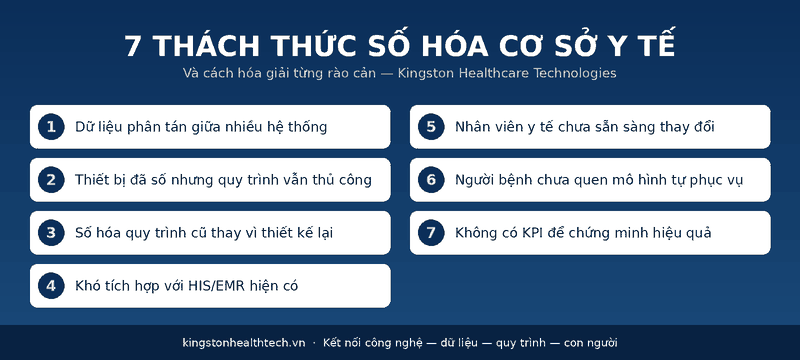
Overview of the 7 Common Challenges in Digitizing Healthcare Facilities
2. Devices Are Digital but Processes Remain Manual
A device with an electronic display does not necessarily create a digital process. For example, a blood pressure monitor may display results automatically, but if a nurse still has to read the result → write it on a form → re-enter it into the HIS, most of the operational steps remain non-automated.
The consequence is often longer processing time, repetitive tasks, a risk of input errors, and difficulty scaling as patient volume increases.
How to solve it: assess the device's connectivity capabilities
When choosing a digital medical device, in addition to technical specifications, it is important to consider: whether the device can export data, whether it has an API or middleware, whether results can be correctly linked to the patient's record, and whether data can flow directly into the management system.
Note: A device within a digital healthcare ecosystem should be viewed as a data-generating point, not just a measuring instrument. This is also the direction taken by Kingston Healthcare Technologies' Medi-Kiosk, in which the measurement process, user guidance, and data recording are organized within a single digitized journey.
3. Digitizing Old Processes Instead of Redesigning Them
A common mistake is putting the current process onto software without changing how it operates. If a process with 10 manual steps is moved onto a screen but still keeps all 10 steps, the resulting benefit can be very limited.
Old process + new technology does not necessarily create digital transformation. For example, patients still have to declare the same information multiple times, wait at multiple counters, go through multiple measurement areas, and wait for staff to enter data. In this case, converting paper forms into electronic forms only solves a very small part of the problem.
How to solve it: redesign first, digitize second
Before each step, three questions should be asked: is this step truly necessary, can it be automated, and must it be performed by healthcare staff?
4. Difficulty Integrating with Existing HIS/EMR
“Can this solution connect with our current system?” is a key question in almost every healthcare digitization project. There is no single answer that applies to all facilities — integration capability depends on the HIS/EMR in use, the system's API, data structure, user authentication method, server or cloud infrastructure, security policies, and IT department requirements.
How to solve it: Integration-first instead of Device-first
Integration should not be left until the end of the project. From the very beginning, there needs to be agreement on how data is transmitted, how patients are identified, and what the backup process is if a connection fails. A modern device that operates independently of the overall system will deliver limited digital transformation value.
5. Healthcare Staff Not Ready for Change
A system may be technically sound but fail in practice if users find it difficult to operate, more time-consuming, an added burden, impractical, or if they don't understand its benefits. This is why digital transformation cannot be solely an IT department project.
How to solve it: involve users from the design stage
Before deployment, it's important to observe actual work: what tasks nurses are performing, what data doctors need, which points consume the most time, which steps are repeated most often, and where staff commonly make errors. Technology should be designed to reduce work, not add to it.
A pilot is also a necessary step to test the process, gather feedback, adjust the interface, train staff, and identify issues before scaling up.
6. Patients Not Yet Accustomed to Self-Service Models
Kiosks, QR codes, and self-service processes can be very convenient for one group of users but difficult for another — especially the elderly, first-time users, and people with limited vision. If not well-designed, a health checkup kiosk can create a new bottleneck.
How to solve it: design technology for real-world users
A self-service healthcare interface should prioritize: large font sizes, fewer steps, clear action buttons, visual instructions, short content, feedback after each action, and guidance to redo a measurement if it wasn't done correctly. In the early stages, support staff should still be available.
The goal is not to have everyone self-serve 100%. The goal is for those who can operate independently to do so, allowing staff to focus support on the groups that need it. Good technology doesn't replace people; it helps human resources be used more effectively. See details of the health checkup process using kiosks to better understand each operational step.
7. No KPIs to Demonstrate Return on Investment
A digitization project can easily end with the statement: “The system has been deployed.” But the more important question is: “What has actually improved after deployment?” Without before-and-after data, it is very difficult to assess effectiveness.
How to solve it: establish KPIs before the pilot
A healthcare facility can start with a simple set of indicators:
There's no need to track too many KPIs from the start. It's enough to clearly define: which problem needs to be solved → which indicator proves that problem has been improved.
How Should an Effective Digitization Model Operate?
Instead of devices operating independently, a digital healthcare journey can be designed around a continuous data flow:
Patient
↓
Medi-Kiosk / digital medical device
↓
Health data recorded
↓
Management platform
↓
HIS / EMR when integration conditions are met
↓
Doctors and healthcare staff
↓
Consultation – Monitoring – Continued Care
The value does not lie in how many devices a healthcare facility has. The value lies in whether data can flow continuously throughout the entire care journey. This is the difference between deploying a single device and building a digital healthcare ecosystem.
Medi-Kiosk and Medi-Case in the Digitization Journey
Kingston Healthcare Technologies develops Medi-Kiosk and Medi-Case with a focus on connecting devices, data, and care processes.
Medi-Kiosk: Digitizing the Screening Point
Depending on the configuration, Medi-Kiosk can help record height, weight, BMI, blood pressure, heart rate, SpO₂, and body temperature. Users are guided step by step, while results are digitized right at the measurement point. Medi-Kiosk can be studied for application in hospitals, clinics, health stations, enterprises, and community healthcare programs.
Medi-Case: Extending Care Beyond the Facility
Medi-Case is designed for a flexible health checkup model, suited to community programs, mobile checkups, enterprises, areas far from healthcare facilities, and models that need Telehealth connectivity. The common point is that data is generated right at the point of care and can continue to be managed within a suitable ecosystem. This is also the foundation of the employee health management solution that many businesses are now adopting.
Digitization Roadmap: Start from the Problem, Not the Device
A practical roadmap for digitizing a healthcare facility can include 5 steps:
Identify the bottleneck
Where is time, manpower being wasted, or errors occurring the most?
Map the current process
Where does the patient go? Who performs each action? At which step is data entered?
Choose a priority problem
There's no need to digitize the entire facility at once.
Pilot
Test it in one department, one station, or one specific process.
Measure, then scale
Pilot → Measure → Adjust → Standardize → Scale up.
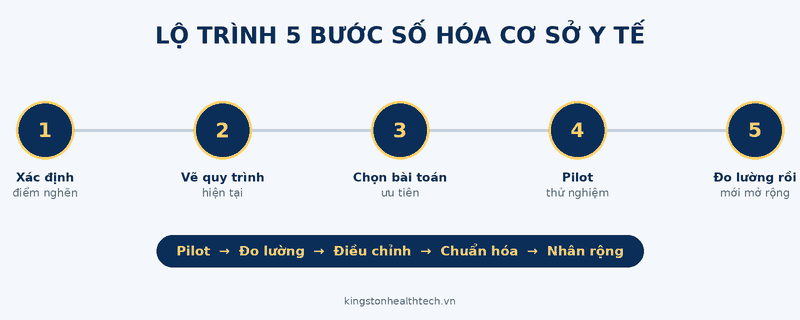
5-Step Roadmap for Deploying Healthcare Digitization
This approach helps reduce risk and verify effectiveness before large-scale deployment. This approach is also similar to the experience of deploying healthcare kiosks at many facilities that Kingston Healthcare Technologies has accompanied, as well as the general direction the World Health Organization (WHO) recommends in its global digital health strategy.
💡 Note: Digitizing a healthcare facility is an ongoing process, not a project that ends after deployment. Measuring and adjusting after the pilot is just as important as the initial technology selection phase.
🏥 Kingston Healthcare Technologies – Building Connected Healthcare
KHT partners with hospitals, healthcare facilities, businesses, and localities to build connected healthcare touchpoints through Medi-Kiosk, Medi-Case, and integrated solutions.