
Along with digital health transformation, more and more hospitals, clinics, businesses, and healthcare facilities in Vietnam are showing interest in solutions that automate intake, screening examinations, and health data management.
🏥 Health kiosks are commonly known for functions such as scanning ID cards, registering for examinations, issuing queue numbers, or paying hospital fees. However, alongside this group of administrative kiosks, a more specialized type of device is emerging on the market: Health check-up kiosks.
Unlike ordinary registration kiosks, health check-up kiosks can integrate multiple digital medical devices to measure vital signs, record data, and support initial health screening before users see a doctor.
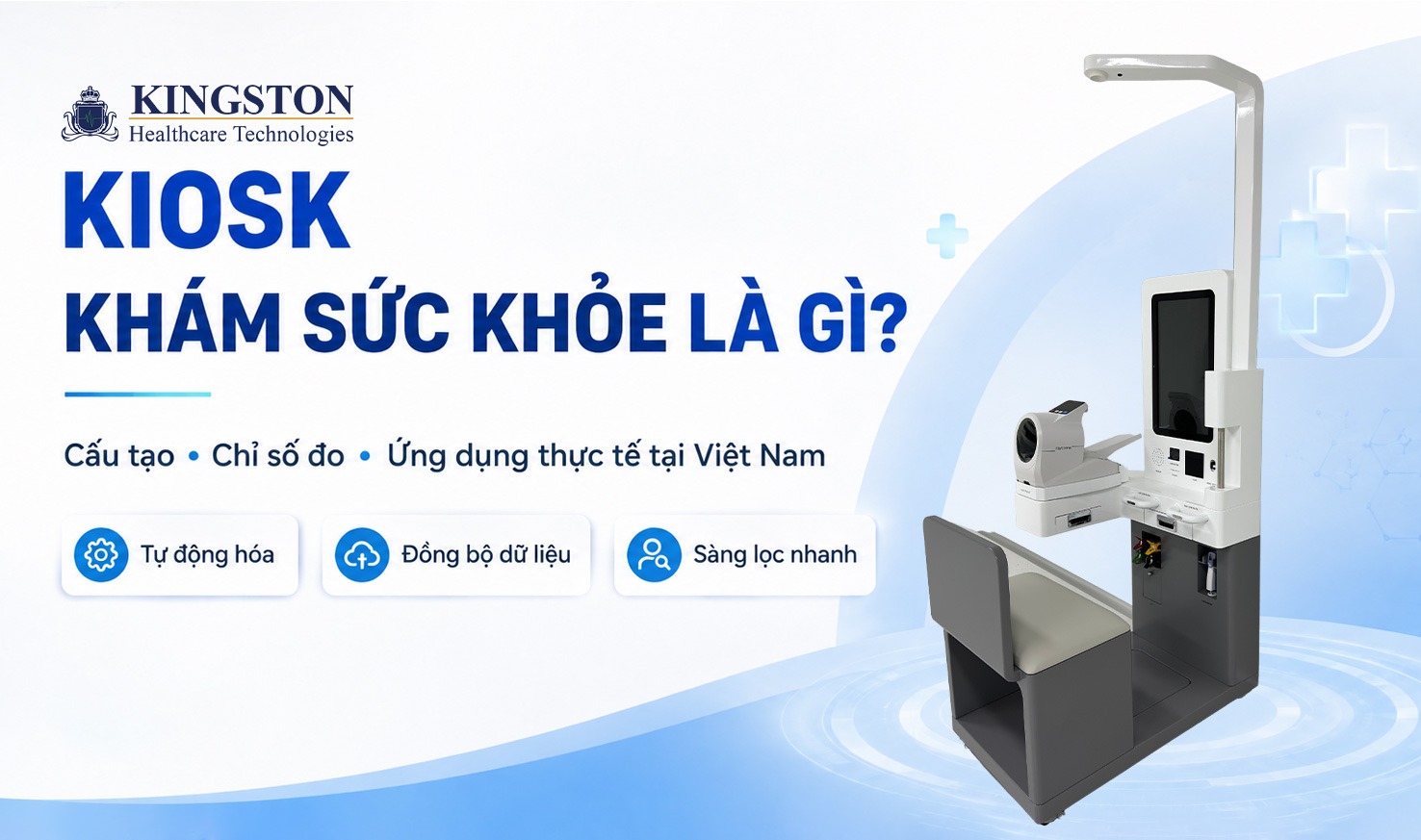
A health check-up kiosk integrates multiple vital-sign measurement devices to support initial health screening.
🔍 Definition: Distinguishing the 3 types of health kiosks currently in Vietnam
The term “health kiosk” is now used for many types of devices with different functions. Distinguishing each group clearly helps healthcare facilities choose the right solution for their deployment needs.
The administrative kiosk is the most common type, focused on digitizing administrative procedures but not measuring any health indicators. The payment kiosk is dedicated to the fee-payment step, usually placed at the discharge area or cashier counter.
Meanwhile, the clinical screening kiosk is the least discussed group, yet it addresses an important part of the examination process: automatically measuring vital signs before a patient sees a doctor. This is the type of health check-up kiosk that this article focuses on analyzing, and it is also the direction that health technology companies in Vietnam, including Kingston Healthtech, are pursuing with their product Medi-Kiosk.
🛠️ Structure of a health check-up kiosk
A complete health check-up kiosk typically consists of four layers.
Hardware is the machine frame, designed as a seated or standing station, ensuring stability while the user takes measurements over a few minutes. The ergonomic design helps reduce errors caused by incorrect posture, which is especially important for elderly people or those with limited mobility.
Sensors and measurement devices are the component that determines the kiosk's screening capability, and may include height–weight sensors, a bioelectrical impedance body composition analyzer, an automatic blood pressure monitor, an SpO2 sensor, a digital thermometer, an ECG module, a blood glucose/HbA1c meter, and a cholesterol meter, depending on the product configuration.
Screen and interface is usually a large touchscreen (typically around 24 inches, Full HD resolution) that displays intuitive step-by-step instructions, allowing users to perform measurements on their own without direct assistance from healthcare staff.
Data platform is the back-end layer, responsible for storing measurement results, syncing with the hospital information system (HIS), electronic medical records (EMR), or the user's electronic health record, while also supporting Telehealth connectivity for remote consultation models.
📊 What indicators can a kiosk measure?
The list of indicators a health check-up kiosk can measure depends on the configuration of devices integrated into it. The table below summarizes the common groups of indicators found on health check-up kiosks today.
It should be emphasized that these indicators are for screening and initial reference purposes; results measured at the kiosk do not replace a specialist doctor's diagnosis. According to World Health Organization (WHO), hypertension is one of the leading risk factors for cardiovascular disease and stroke, highlighting the value of early screening using devices such as health check-up kiosks.
🧭 The 5-step process a user experiences
The experience of using a health check-up kiosk typically follows five seamless steps.
What problem does a kiosk solve for healthcare facilities?
For hospitals, clinics, and corporate health check-up programs, health check-up kiosks directly address several common operational bottlenecks.
First is congestion in the waiting area during peak hours, when the number of people coming for screening spikes. Second, kiosks reduce the workload for reception staff and nurses, who previously had to manually measure vital signs for each person.
Third, measured data is recorded and standardized automatically, significantly reducing errors compared to manual record-keeping. Finally, for large-scale health check-up programs such as corporate check-ups, community screening, or school health programs, kiosks help significantly shorten the processing time per visit while still maintaining input data quality.
In practice, this model is already being applied by several organizations in Vietnam across different contexts: from commune/ward health stations, corporate clinics, community screening programs, to school health events — demonstrating the flexibility of health check-up kiosks when deployed at various scales and locations.
🧩 Deployment requirements: infrastructure, HIS/EMR integration, data security
Before installing a health check-up kiosk, a healthcare facility needs to prepare certain foundational conditions.
In terms of infrastructure, there needs to be sufficient space in the waiting area, a stable power source, and network connectivity (Ethernet or Wi-Fi) to ensure data is transmitted continuously. Deploying units typically conduct an on-site survey before installation to determine the optimal kiosk location, avoiding obstruction of patient flow.
In terms of software, the kiosk needs to be able to integrate with the hospital information system (HIS) or electronic medical records (EMR) already in use at the facility, so that measurement data syncs directly into patient records without needing to be re-entered. This process is usually accompanied by a connection testing phase and operator training before official use.
In terms of security, since vital sign data is sensitive medical information, the system must comply with strict data security standards and have clear access-control mechanisms between departments.
Criteria for choosing a health kiosk provider
As this is a long-term investment directly involving patients' health data, choosing a health kiosk provider should be carefully evaluated against the following criteria:
These are also the criteria that health technology companies in Vietnam, including Kingston Healthtech, are building their products to meet simultaneously, with systems such as Medi-Kiosk and Registration Kiosk.
⚠️ Important note: Medical devices are for reference purposes only; measurement results should be compared with a specialist doctor's opinion.
🏥 Learn about the health check-up kiosk solution for your facility
Kingston Healthtech works alongside hospitals, clinics, and businesses to deploy Medi-Kiosk solutions suited to real-world scale.